
Why Safety Standards Matter in Tactical Manufacturing When sourcing tactical gloves for military or industrial use, understanding safety ratings is critical. The two main global standards are the European EN 388 and the American ANSI/ISEA 105. As a manufacturer, TraCombat Industries adheres to both to ensure our clients get the exact protection level they require.
1. Understanding EN 388 (The European Standard)
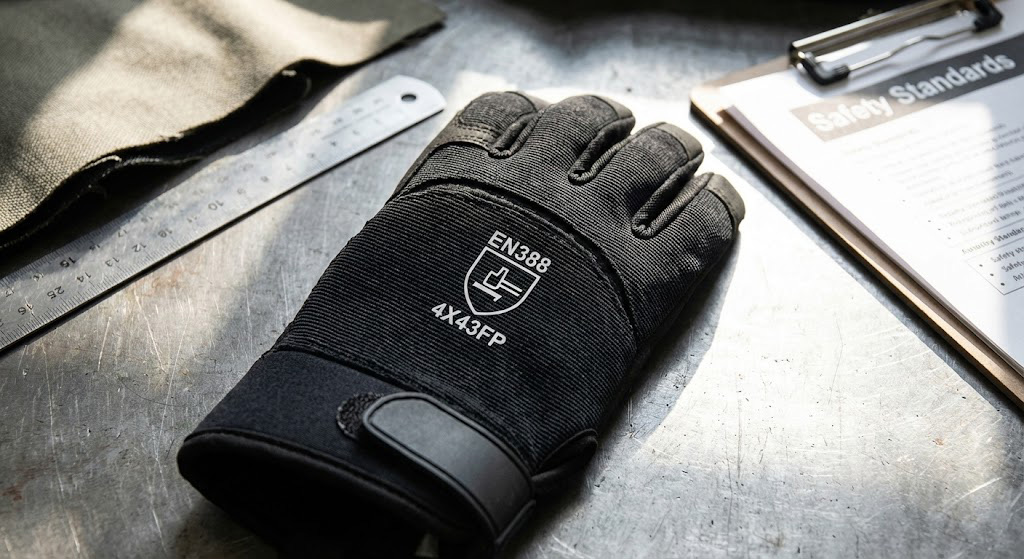
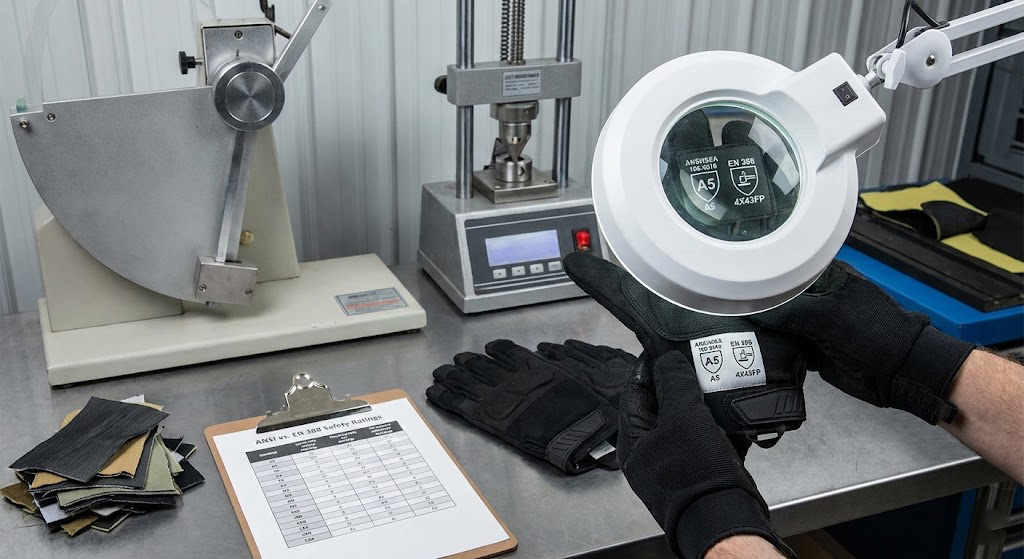
EN 388 is the standard used primarily in Europe, Asia, and South America. You will often see a shield icon with 4 numbers and 2 letters under it (e.g., 4X43FP).
-
Abrasion Resistance (1-4): How many cycles of sandpaper the glove can withstand.
-
Cut Resistance (Coupe Test) (1-5): Protection against slicing.
-
Tear Resistance (1-4): Force required to rip the material.
-
Puncture Resistance (1-4): Protection against a pointed object.
-
ISO Cut Resistance (A-F): A newer, more accurate cut test for high-level protection.
2. Understanding ANSI/ISEA 105 (The US Standard)
The American National Standards Institute (ANSI) uses a more granular scale for cut resistance, which is preferred for high-risk environments.
A7-A9: Extreme protection (heavy industrial risks).
Cut Levels A1 – A9:
A1-A3: Light protection (general material handling).
A4-A6: Medium/High protection (glass handling, sharp metal).
3. Which Standard Should You Choose?
If you are bidding on a US Government tender, ANSI is usually the requirement. For global exports to Europe or the Middle East, EN 388 is the standard.
4. TraCombat’s Manufacturing Guarantee
At TraCombat Industries, we design gloves to meet your specific safety requirements. We can manufacture gloves that achieve ANSI A9 for extreme risks or cost-effective EN 388 Level 3 gloves for general duty. We provide full lab testing reports for our B2B partners.